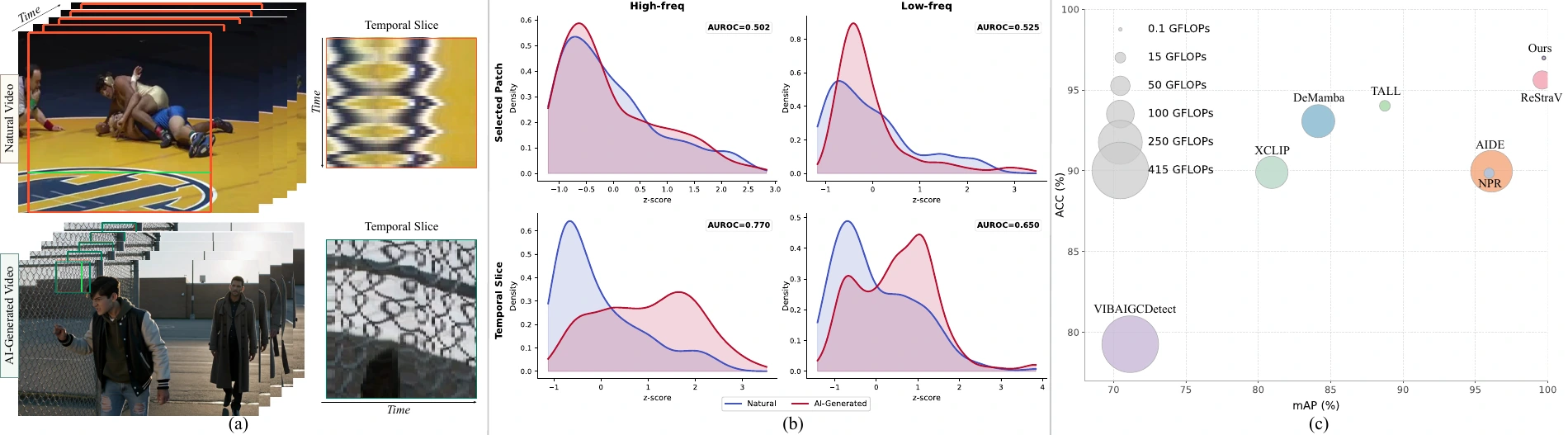
Less redundant appearance. More informative temporal evolution.
Temporal slices reveal localized evolution with a compact representation. Examples, response distributions, and the performance–computation trade-off. Open figure ↗
01 / OVERVIEW
Abstract
Recent advances in generative video models have significantly improved visual realism, making detection increasingly dependent on subtle temporal inconsistencies arising from imperfect frame-to-frame coherence. However, these signals are weak and spatially localized, while most of the video content is redundant. This creates a fundamental mismatch: existing detectors rely on heavy backbones to model full videos, assuming increased capacity can capture such cues, which leads to high computational cost and limited scalability.
In this work, we rethink AI-generated video detection from a representation perspective. Instead of modeling entire videos, we propose to explicitly restructure them into compact temporal slice representations that isolate informative temporal evolution. Based on this idea, we introduce a lightweight framework using frequency-aware temporal slice consistency learning, where informative spatial rows and columns are aggregated over time to form slice-domain inputs. This reparameterization suppresses redundant appearance while preserving discriminative temporal dynamics, enabling efficient and targeted detection. By constructing slices from both high- and low-frequency regions, our method exposes complementary temporal artifacts, including unstable details and abnormal motion smoothness. We instantiate this idea in a Temporal Slice Consistency Network (TSC-Net), which integrates task-driven slice localization, hierarchical positional encoding, and a lightweight Transformer to model cross-slice and cross-frequency dependencies with minimal overhead. We further introduce AI-Artist, a new benchmark with artist-curated videos from recent high-fidelity generators, including Seedance and Kling. Experiments on GenVideo and AI-Artist show that our method achieves strong performance while requiring over 400× fewer model-forward FLOPs and 3.6× faster model inference than the strong video-based baseline ReStraV (2.9× faster end to end, including preprocessing), enabling scalable and practical deployment.
02 / THE REPRESENTATION MATTERS
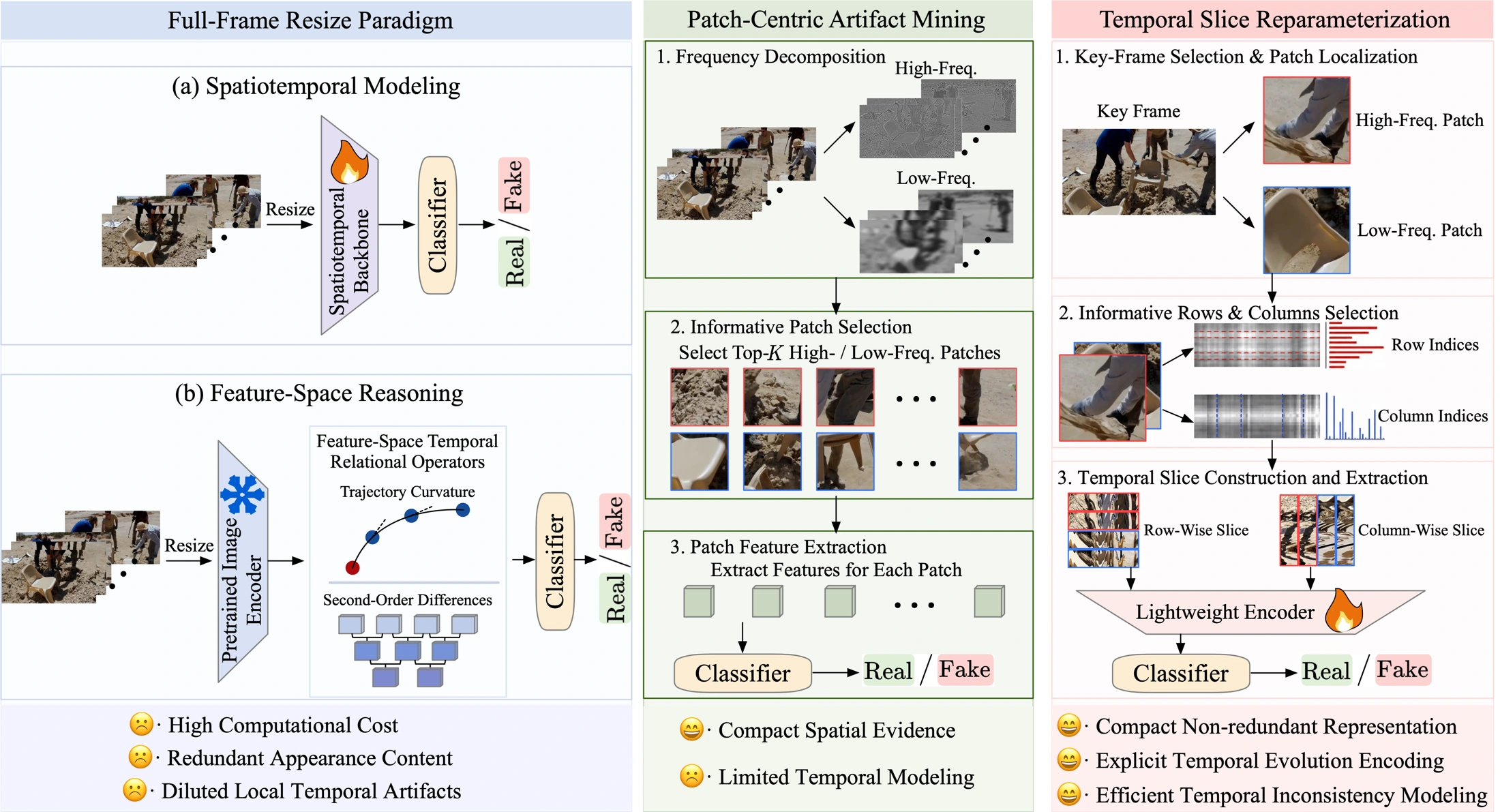
Looking Beyond Full-Frame Appearance
Generation artifacts can be subtle, spatially localized, and temporal.
THE QUESTION
Do we need to process every pixel in a video?
What information do we really need? Full frames preserve substantial appearance redundancy. Spatial patches isolate local evidence. Temporal slices explicitly expose how local regions evolve over time.
Temporal slices reorganize a video to make localized temporal evolution visible, while discarding much of the redundant full-frame appearance. High- and low-frequency regions provide complementary evidence about unstable details and abnormal motion smoothness.
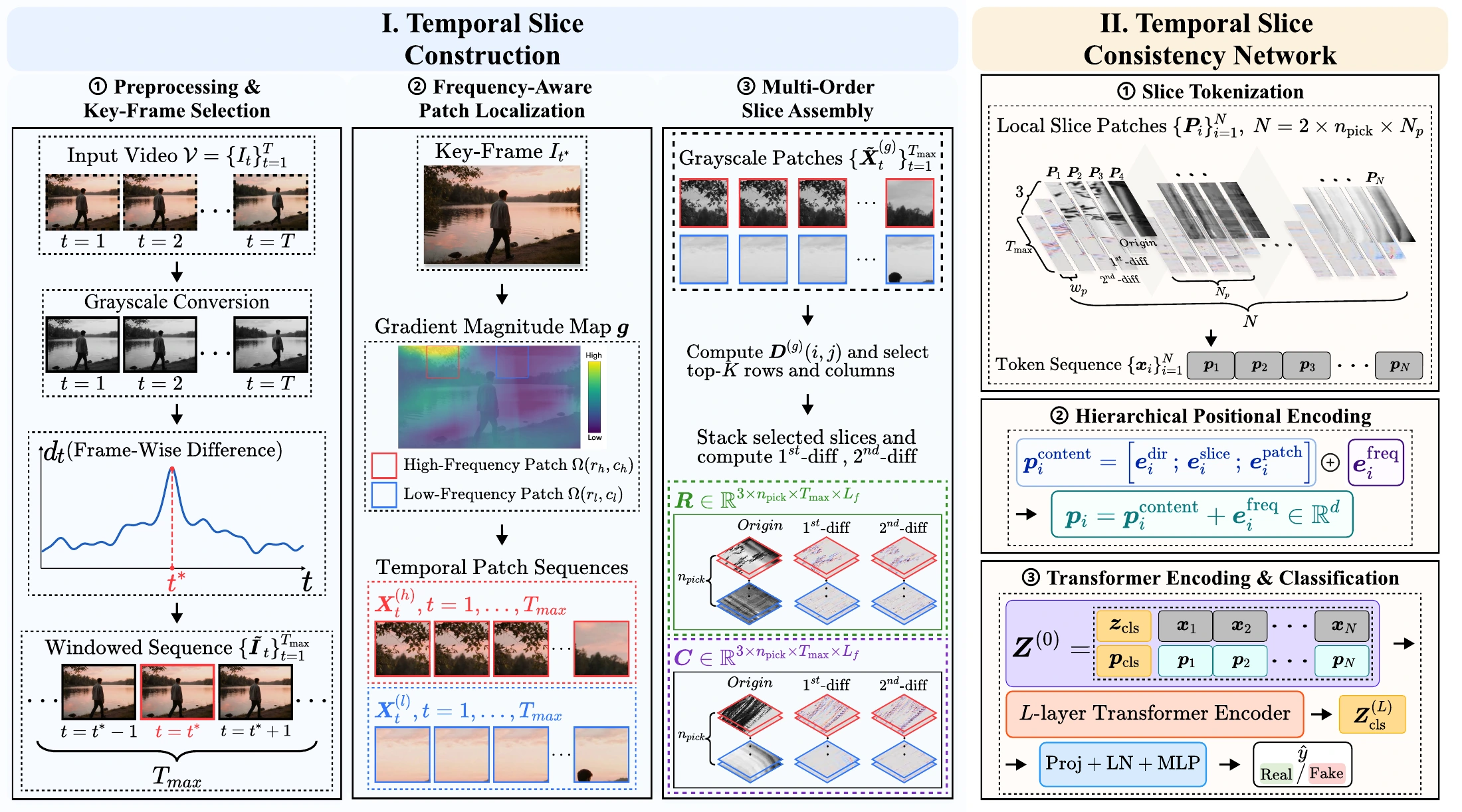
Temporal Slice Consistency Network (TSC-Net) restructures the input to preserve temporal signals with a lightweight network.
Two stages, one compact pipeline. Temporal slice construction (left) and temporal slice consistency modeling (right). Open full-resolution figure ↗
Use one content-preserving crop across frames. Select the key frame by maximal frame-wise variation and form an eight-frame temporal window.
EFFICIENCY · PAPER BENCHMARK
1.731M
parameters
0.109
model GFLOPs · ReStraV: 44.20
3.6×
faster model inference vs. ReStraV
2.9×
faster end to end vs. ReStraV
Benchmark measurements follow the experimental settings reported in the paper. The reported 1.478 ms model time is not an online CPU latency; online processing includes video decoding and depends on server load.
04 / EXPLORE THE DETECTOR
Try TSC-Net on Your Video
Explore temporal-slice-based AI-generated video detection.
Temporarily unavailable
Online inference is not enabled. The research figures above remain available to explore.
Video input
MP4 / MOV / WebM
Video uploads will open when the inference service is available.
One result per shot. Eight frames are sampled across each shot’s full duration.
Detection result
No analysis yet
≈
A different perspective on video.
Shot boundaries are detected first. Each eligible shot is analyzed using eight frames sampled across its full duration.
Training data. The model was trained only on GenVideo; no additional training datasets were used. Performance may vary across generators and video sources.
About the demo speed. This demo runs on a shared free CPU instance (0.1 CPU, 512 MB RAM). Server processing time includes video decoding, preprocessing, and inference on eight full-span frames per eligible shot. High-resolution or high-frame-rate inputs are resized or resampled before analysis and can take more time. Upload and service wake-up add to the wait. These timings are not directly comparable to the paper’s benchmark measurements.
Precomputed examples
Previously computed results, explicitly separate from live inference.
About this demo and your video +
Uploaded videos are sent to a server-side inference service. No model runs in your browser. Due to commercial restrictions, the source code and model weights cannot be publicly released.
Availability is limited. A sleeping free CPU instance may take about a minute to start. Uploads remain disabled whenever the service is unavailable or busy. There is no automatic retry or background keep-alive.
Online upload is currently disabled. Retention information will be displayed before an approved service accepts videos.
05 / REFERENCE
Citation
Please use the arXiv citation for now. The NeurIPS entry below will be updated with the final publication details.
@article{shang2026temporalslicelearningaigenerated,
  title={Temporal Slice Learning for {AI}-Generated Video Detection with 400$\times$ Fewer {FLOPs}},
  author={Shang, Wei and Li, Zhiyuan and He, Shengfeng},
  journal={arXiv preprint arXiv:2610.35148},
  year={2026}
}
NeurIPS 2026
Publication details pending. Volume and page numbers will be added after publication.
@article{shang2026temporal,
  title={Temporal Slice Learning for {AI}-Generated Video Detection with 400$\times$ Fewer {FLOPs}},
  author={Shang, Wei and Li, Zhiyuan and He, Shengfeng},
  journal={Advances in Neural Information Processing Systems},
  volume={},
  pages={},
  year={2026}
}